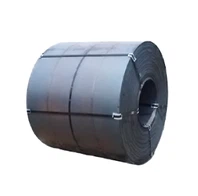
As a dedicated supplier of A387 steel plates, I often encounter various technical inquiries from clients. One question that frequently arises is about the Poisson's ratio of A387 steel plate. In this blog, I'll delve into what the Poisson's ratio is, its significance for A387 steel plates, and how it impacts practical applications.
Understanding Poisson's Ratio
Poisson's ratio is a fundamental material property that describes the relationship between lateral strain and axial strain when a material is subjected to an axial load. When a material is stretched or compressed in one direction (axial direction), it will also deform in the perpendicular (lateral) directions. Poisson's ratio, denoted by the Greek letter ν (nu), is defined as the negative ratio of the lateral strain (ε_lateral) to the axial strain (ε_axial):
ν = - ε_lateral / ε_axial
For most isotropic materials, Poisson's ratio ranges between 0 and 0.5. A value of 0 would mean that the material does not deform laterally when subjected to an axial load, while a value of 0.5 would imply that the volume of the material remains constant during deformation.


Poisson's Ratio of A387 Steel Plate
A387 steel is a chromium - molybdenum alloy steel commonly used in high - temperature pressure vessel applications. The Poisson's ratio of A387 steel plate typically falls in the range of approximately 0.27 to 0.30. This value is characteristic of many metallic materials, indicating that when A387 steel is stretched or compressed axially, it will contract or expand laterally in a predictable manner.
The specific value within this range can be influenced by several factors, including the exact chemical composition of the steel, its heat treatment history, and the presence of any impurities or inclusions. For example, a higher carbon content or the addition of certain alloying elements may slightly alter the material's internal structure, which in turn can affect the Poisson's ratio.
Significance in Engineering Applications
The Poisson's ratio of A387 steel plate is of great importance in engineering design and analysis. Here are some key areas where it plays a crucial role:
Structural Design
In the design of pressure vessels and other high - stress structures made from A387 steel, engineers need to account for the lateral deformation caused by axial loading. The Poisson's ratio affects the overall stress distribution within the structure. For instance, when a pressure vessel is pressurized, the internal pressure creates an axial stress. Due to the Poisson's effect, the vessel will also experience a lateral stress, which must be considered to ensure the structural integrity and safety of the vessel.
Material Testing and Quality Control
During material testing, knowledge of the Poisson's ratio is essential for accurately interpreting test results. For example, in a tensile test, the lateral contraction of the specimen is measured along with the axial elongation. By comparing these values and using the known Poisson's ratio of A387 steel, engineers can calculate the true stress and strain values, which are more representative of the material's behavior under load. This information is crucial for determining the mechanical properties of the steel, such as its yield strength and ultimate tensile strength.
Finite Element Analysis (FEA)
FEA is a powerful tool used in engineering to simulate the behavior of structures under various loading conditions. The Poisson's ratio is one of the input parameters required for accurate FEA models of A387 steel structures. By incorporating the correct Poisson's ratio, engineers can obtain more realistic predictions of stress, strain, and deformation, which helps in optimizing the design and reducing the risk of failure.
Comparison with Other Pressure Vessel Steels
To better understand the Poisson's ratio of A387 steel plate, it's useful to compare it with other common pressure vessel steels such as SA285GrA, SA516GR70, and P295GH.
SA285GrA is a carbon steel used for moderate - temperature pressure vessels. Its Poisson's ratio is also in the range of 0.27 - 0.30, similar to A387 steel. This similarity indicates that both steels will exhibit comparable lateral deformation characteristics under axial loading.
SA516GR70 is another popular carbon steel for pressure vessel applications, especially in low - temperature service. Like A387 and SA285GrA, its Poisson's ratio typically falls within the 0.27 - 0.30 range. This consistency in Poisson's ratio among different pressure vessel steels simplifies the design process, as engineers can often use similar assumptions for lateral deformation in their calculations.
P295GH is a European standard steel used for pressure vessels in the power generation and petrochemical industries. It also has a Poisson's ratio in the general range of 0.27 - 0.30, highlighting the common behavior of metallic materials under axial loading.
Impact on Manufacturing Processes
The Poisson's ratio of A387 steel plate also has implications for manufacturing processes. When forming A387 steel into complex shapes, such as bending or rolling, the lateral deformation due to the Poisson's effect must be considered. For example, during the bending process, the outer surface of the bend is in tension and will contract laterally, while the inner surface is in compression and will expand laterally. If the Poisson's ratio is not properly accounted for, it can lead to issues such as wrinkling, cracking, or inaccurate dimensions in the final product.
Conclusion and Call to Action
In conclusion, the Poisson's ratio of A387 steel plate is a critical material property that influences its behavior in engineering applications, from structural design to manufacturing processes. With a typical value in the range of 0.27 - 0.30, it provides engineers with a reliable parameter for predicting the lateral deformation of the material under axial loading.
If you are in the market for high - quality A387 steel plates or have any questions regarding their technical properties, including the Poisson's ratio, I invite you to reach out for a detailed discussion. Our team of experts is ready to assist you in finding the best solutions for your specific requirements. Whether you are involved in pressure vessel manufacturing, power generation, or other industries that rely on A387 steel, we can provide you with the right products and support.
References
- ASME Boiler and Pressure Vessel Code, Section II - Materials
- "Metals Handbook", ASM International
- Technical literature from steel manufacturers on A387 steel properties