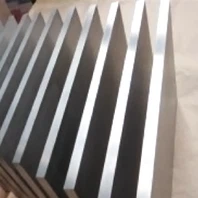
As a reliable supplier of 1045 steel plates, I am often asked about the properties of this versatile material. In this blog post, I will delve into the key characteristics of 1045 steel plates, which will help you understand why it is a popular choice in various industries.
Chemical Composition
The chemical composition of 1045 steel plate plays a crucial role in determining its properties. It typically contains approximately 0.42 - 0.50% carbon (C), 0.60 - 0.90% manganese (Mn), up to 0.040% phosphorus (P), up to 0.050% sulfur (S), and the rest is iron (Fe) with small amounts of other elements. The relatively high carbon content gives 1045 steel its strength and hardness, while the manganese helps improve its hardenability and tensile strength.


Mechanical Properties
Tensile Strength
One of the most important mechanical properties of 1045 steel plate is its tensile strength. Generally, the tensile strength of 1045 steel plate ranges from 570 - 700 MPa. This high tensile strength makes it suitable for applications where the material needs to withstand significant pulling forces without breaking. For example, in the manufacturing of shafts, axles, and gears, the high tensile strength of 1045 steel plate ensures that these components can operate under heavy loads without failure.
Yield Strength
The yield strength of 1045 steel plate is typically around 315 - 420 MPa. Yield strength is the point at which a material begins to deform plastically. A relatively high yield strength means that 1045 steel plate can withstand a certain amount of stress before it starts to permanently change shape. This property is essential in applications such as structural components in buildings and machinery, where the material needs to maintain its shape under normal operating conditions.
Elongation
Elongation is a measure of how much a material can stretch before it breaks. 1045 steel plate usually has an elongation of about 17 - 23%. This moderate elongation indicates that the material has a certain degree of ductility, which means it can be formed into various shapes through processes such as forging, rolling, and machining without cracking. For instance, in the production of automotive parts, the ductility of 1045 steel plate allows it to be shaped into complex geometries.
Hardness
The hardness of 1045 steel plate can vary depending on the heat treatment process. In the as - rolled condition, its hardness is relatively low, but through processes like quenching and tempering, the hardness can be significantly increased. For example, after proper heat treatment, the hardness of 1045 steel plate can reach up to 229 - 285 HB (Brinell hardness). This adjustable hardness makes 1045 steel plate suitable for a wide range of applications, from relatively soft components that require good machinability to hard - wearing parts that need to resist abrasion.
Physical Properties
Density
The density of 1045 steel plate is approximately 7.85 g/cm³. This density is typical for most carbon steels and is an important factor in applications where weight is a consideration. For example, in the aerospace and automotive industries, where reducing weight is crucial for improving fuel efficiency, the density of the material needs to be taken into account when designing components.
Thermal Conductivity
The thermal conductivity of 1045 steel plate is about 48.0 W/(m·K). This property is important in applications where heat transfer is involved. For instance, in heat exchangers or engine components, the ability of 1045 steel plate to conduct heat efficiently can help maintain the proper operating temperature of the equipment.
Machinability
1045 steel plate has good machinability, especially in the normalized or annealed state. Its relatively uniform structure and moderate hardness allow for easy cutting, drilling, and milling. This makes it a cost - effective choice for manufacturing processes that involve a lot of machining operations. For example, in the production of small - to - medium - sized machine parts, the good machinability of 1045 steel plate can reduce production time and costs.
Weldability
1045 steel plate can be welded using various welding methods, such as arc welding, gas welding, and resistance welding. However, due to its relatively high carbon content, pre - heating and post - welding heat treatment may be required to prevent cracking and ensure the quality of the weld. When welding 1045 steel plate, proper welding procedures and techniques should be followed to obtain strong and reliable welds.
Corrosion Resistance
In its untreated state, 1045 steel plate has relatively poor corrosion resistance. It is prone to rusting when exposed to moisture and oxygen in the environment. However, various surface treatment methods can be applied to improve its corrosion resistance. For example, painting, galvanizing, or applying a protective coating can effectively protect the steel plate from corrosion. In applications where the steel plate is exposed to harsh environments, such as in marine or chemical industries, these surface treatments are essential to ensure the long - term durability of the material.
Applications
Due to its excellent combination of properties, 1045 steel plate is widely used in many industries. In the automotive industry, it is used to manufacture parts such as crankshafts, connecting rods, and gears. In the machinery industry, it is used for making shafts, spindles, and couplings. In the construction industry, it can be used for structural components in buildings and bridges.
Compared with other steel materials, such as P335GH, SA285GrC A387GR11CL2, and P295GH, 1045 steel plate offers a different set of properties. These other materials are often used in specific applications such as pressure vessels, where they have better performance in terms of high - temperature strength and corrosion resistance in certain environments. However, 1045 steel plate's strength, machinability, and cost - effectiveness make it a popular choice for a wide range of general - purpose applications.
If you are interested in purchasing 1045 steel plates for your specific application, I encourage you to contact me for further discussion. We can talk about your requirements, such as the size, quantity, and any special treatment you may need. Our team of experts is ready to provide you with the best solutions and high - quality products.
References
- ASM Handbook Volume 1: Properties and Selection: Irons, Steels, and High - Performance Alloys
- Metals Handbook Desk Edition, Third Edition