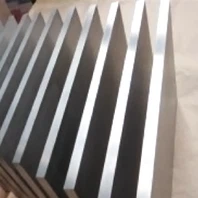
Hey there! I'm a supplier of low alloy steel plates, and today I wanna talk about something super important in the steel world: the yield strength of low alloy steel plates.
First off, let's get clear on what yield strength actually means. Yield strength is the stress at which a material begins to deform plastically. In simpler terms, it's the point where the steel stops acting like a spring (going back to its original shape when the force is removed) and starts to change shape permanently. For low alloy steel plates, this is a crucial property because it determines how much load the plate can handle before it starts to lose its structural integrity.
Low alloy steel plates are made by adding small amounts of alloying elements like manganese, nickel, chromium, and molybdenum to carbon steel. These elements improve the steel's mechanical properties, including its yield strength. Different combinations and amounts of these elements result in various grades of low alloy steel plates, each with its own unique yield strength.
One of the most common grades of low alloy steel plates is A633GRD Low Alloy Steel Plate. This grade is known for its good strength and toughness, especially in low - temperature environments. The yield strength of A633GRD typically ranges from 345 MPa (megapascals) to 415 MPa, depending on factors like the plate thickness and the manufacturing process. That's a pretty decent amount of strength, which makes it suitable for a wide range of applications, such as building structures, bridges, and pressure vessels.
Another well - known grade is S355JR. As the name suggests, S355JR has a minimum yield strength of 355 MPa. It's a popular choice in the construction industry because it offers a good balance between strength and weldability. You can use it for everything from general construction work to making machinery parts.
Now, you might be wondering how we measure the yield strength of these low alloy steel plates. Well, it's done through a test called the tensile test. In a tensile test, a small sample of the steel plate is taken and pulled in a machine until it breaks. The machine records the amount of force applied and the corresponding deformation of the sample. By analyzing the data, we can determine the yield strength, as well as other important mechanical properties like the ultimate tensile strength and the elongation.
There are several factors that can affect the yield strength of low alloy steel plates. One of the main factors is the chemical composition. As I mentioned earlier, the alloying elements play a big role in determining the strength. For example, increasing the amount of manganese can generally increase the yield strength, but too much of it can also make the steel brittle.
The heat treatment process also has a significant impact on the yield strength. Heat treatment involves heating the steel to a specific temperature and then cooling it at a controlled rate. This can change the microstructure of the steel, which in turn affects its mechanical properties. For instance, quenching and tempering can significantly increase the yield strength of low alloy steel plates.
The manufacturing process, such as rolling and forging, can also influence the yield strength. Rolling can align the grains in the steel, which can improve its strength. Forging, on the other hand, can densify the steel and eliminate internal defects, resulting in higher yield strength.
When it comes to choosing the right low alloy steel plate for your project, the yield strength is just one of the factors you need to consider. You also need to think about other properties like the ultimate tensile strength, the toughness, the corrosion resistance, and the weldability. For example, if you're building a structure in a corrosive environment, you might need a steel plate with good corrosion resistance, even if it means sacrificing a little bit of yield strength.

As a supplier of low alloy steel plates, I understand the importance of providing high - quality products that meet your specific requirements. Whether you need A633GRD Low Alloy Steel Plate for a large - scale construction project or S355JR for a small - scale machinery part, I've got you covered.
If you're interested in purchasing low alloy steel plates, or if you have any questions about the yield strength or other properties of these plates, don't hesitate to get in touch. We can have a detailed discussion about your project, and I'll help you find the best solution for your needs.
In conclusion, the yield strength of low alloy steel plates is a critical property that determines their suitability for different applications. By understanding how it's measured, what factors affect it, and how it varies among different grades, you can make an informed decision when choosing the right steel plate for your project.
References
- ASM Handbook Committee. (2004). ASM Handbook Volume 1: Properties and Selection: Irons, Steels, and High - Performance Alloys. ASM International.
- Steel Construction Institute. (2019). Structural Steel Design Guide. SCI Publishing.