

Products
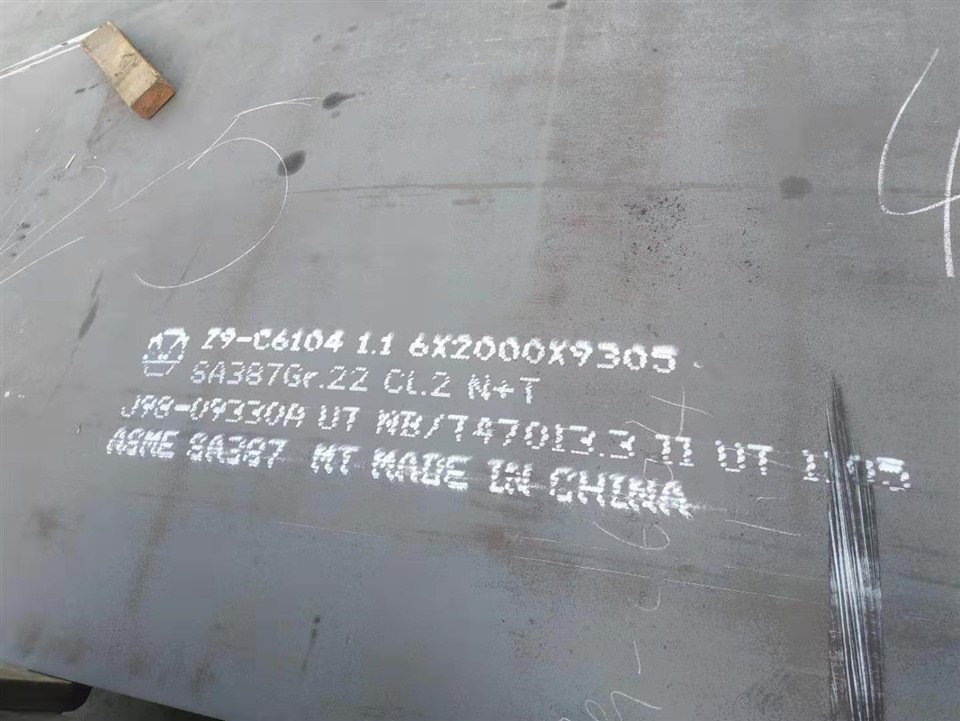
SA387GR11 A387 steel plate
Product introduction
A387 steel plate is an alloy steel plate specially used for the manufacture of high-temperature and high-pressure pressure vessels and heat exchangers. It is mainly composed of alloy elements such as nickel (Ni), chromium (Cr) and molybdenum (Mo). In the petrochemical, oil refining, electric power, nuclear power and other industrial fields, A387 steel plate is widely used in the manufacture of key components such as reactors, steam boilers, pressure vessels, heat exchangers, etc., especially in equipment that needs to withstand high temperatures of 600-650℃ and high pressure environments of 20-30MPa for a long time.
Product parameters
ASTM A387 (ASME SA387)chromium molybdenum alloy pressure vessel steel plate
ASTM A387 Chemical position
|
Steel grade
|
Chemical position % |
|||||||
|
C |
Mn |
P |
S |
Si |
Cr |
Mo |
||
|
A387 Gr.22 CL1/S A387 Gr.22 CL1 A387 Gr.22 CL2/ SA387 Gr.22 CL2
|
Ladle |
0.05-0.15 |
0.30-0.60 |
≤0.025 |
≤0.025 |
≤0.50 |
2.00-2.50 |
0.90-1.10 |
|
Product |
0.04-0.15 |
0.25-0.66 |
≤0.50 |
1.88-2.62 |
0.85-1.15 |
|||
|
A387 Gr.12 CL1/ SA387 Gr.12 CL1 A387 Gr.12 CL2/ SA387 Gr.12 CL2
|
Ladle |
0.05-0.17 |
0.40-0.65 |
0.15-0.40 |
0.80-1.15 |
0.45-0.60 |
||
|
Ladle |
0.04-0.17 |
0.35-0.73 |
0.13-0.45 |
0.74-1.21 |
0.40-0.65 |
|||
|
A387 Gr.11 CL1/ SA387 Gr.11 CL1 A387 Gr.11 CL2/ SA387 Gr.11 CL2
|
Ladle |
0.05-0.17 |
0.40-0.65 |
0.50-0.80 |
1.00-1.50 |
0.45-0.65 |
||
|
Product |
0.04-0.17 |
0.35-0.73 |
0.44-0.86 |
0.94-1.56 |
0.40-0.70 |
|||
ASTM A387Gr22CL2/A387Gr22cl1 A387GR11CL2 Mechanical properties
|
Steel grade |
Class |
Tensile Rm/ MPa |
Yield Rp0.2 /MPa ≥ |
REDUCTION≥ , % |
|
|
|
A200mm |
A50mm |
|||||
|
A387 Gr.22/ SA387 Gr.22 |
CL1 |
415-585 |
205 |
- |
18 |
|
|
CL2 |
515-690 |
310 |
- |
18 |
||
|
A387 Gr.12/ SA387 Gr.12 |
CL1 |
380-550 |
230 |
18 |
22 |
- |
|
CL2 |
450-585 |
275 |
19 |
22 |
- |
|
|
A387 Gr.11/ SA387 Gr.11 |
CL1 |
415-585 |
240 |
19 |
22 |
- |
|
CL2 |
515-690 |
310 |
18 |
22 |
- |
|
Product features
High Temperature Strength
The tensile strength of A387 steel plate at 600°C can reach 450-585 MPa, while the strength of ordinary carbon steel at similar temperatures is only about 300 MPa. At the same time, its yield strength can still remain above 270 MPa at 500°C. This characteristic makes A387 steel plates widely used in high-temperature pressure vessels such as heat exchangers and boiler shells, and can withstand high-temperature and high-pressure environments for a long time without failure.
Strong Corrosion Resistance
The chromium component in the A387 steel plate can form a dense chromium oxide protective film of 0.01-0.05 mm, which can effectively prevent the further development of oxidation and sulfurization. In a simulated corrosion environment containing hydrogen sulfide gas, the corrosion rate of A387 steel plates is only 30% of that of ordinary carbon steel, and its durability can reach more than 15 years. This corrosion resistance makes it the material of choice for refinery towers, chemical vessels and other sulfur gas processing equipment, significantly reducing equipment maintenance costs.
Strong Weldability
The carbon content of A387 steel plates is generally less than 0.15%, making it less prone to cracks during the welding process. The tensile strength retention rate of the steel plate after welding is as high as over 95%, and the impact toughness of the welded joint still reaches 25 J in a -20°C environment. This property makes it suitable for the manufacture of complex structures such as multi-layer pressure vessels and high-temperature piping assemblies for pressure-bearing equipment.
Excellent Heat Treatment Properties
A387 steel plates are usually treated by normalizing (900°C to 950°C) and tempering (650°C to 750°C) to optimize their mechanical properties. Normalizing treatment increases the yield strength to 280-350 MPa and the elongation to more than 20%; tempering further improves the toughness of the material and increases the impact performance to 30 J (at room temperature). This characteristic makes it suitable for use in thermal power station boilers, heat exchangers and other equipment subject to long-term cyclic thermal stress, helping to extend equipment life.
Product applications
High temperature pressure vessels
A387 steel plates are widely used in the manufacture of high temperature pressure vessels such as boiler shells, heat exchangers and chemical reactors. They can withstand high temperature and high pressure environments for a long time to ensure the safe operation of equipment.
Petrochemical equipment
Due to its good resistance to sulfur-containing gases and corrosive media, A387 steel plates are often used in equipment such as refineries, desulfurization equipment, gas separation devices and chemical storage tanks, which can extend the service life of equipment and reduce maintenance frequency.
Power plant boilers
In thermal power and nuclear power plants, A387 steel plates are used for components such as boiler superheaters, economizers and steam pipes.
Shipbuilding and marine engineering
In ship boilers and marine engineering equipment, A387 steel plates can be used to build steam boilers, ballast water systems and deep-sea chemical reaction vessels.
Pressure pipeline manufacturing
A387 steel plates are widely used in the manufacture of pressure pipelines that transport high temperature and high pressure media, such as oil and natural gas pipelines, to ensure the safety and durability of the pipelines.
FAQs
Q: What grades of A387 steel plates are there?
A: Common A387 steel plate grades include A387 Gr.11, Gr.12, Gr.22, etc. Different grades have slightly different chromium and molybdenum contents and are suitable for different working conditions.
Q: What is the corrosion resistance of A387 steel plates?
A: A387 steel plates form an oxide protective film through chromium to protect the interior from corrosion and are suitable for sulfur-containing environments and corrosive media such as petrochemical equipment.
Q: What is the thickness and size range of A387 steel plates?
A: The thickness range of A387 steel plates is 6mm to 150mm, the width is 1500mm to 2500mm, and the length can reach 12000mm, which can be customized according to needs.
Q: What industries are A387 steel plates suitable for?
A: A387 steel plates are widely used in industries such as petrochemical equipment, boiler shells, heat exchangers, high-temperature pipelines, and energy engineering.
Q: Does A387 steel plate require special heat treatment?
A: Yes, A387 steel plates are usually normalized (900-950℃) and tempered (650-750℃) to improve their fatigue resistance and toughness.
Hot Tags: SA387GR11 A387 steel plate, China SA387GR11 A387 steel plate manufacturers, suppliers, factory, pressure vessel plate market standards, pressure vessel plate delivery standards, pressure vessel plate packaging standards, pressure vessel plate testing standards, pressure vessel plate inspection standards, pressure vessel plate price standards


