

Products
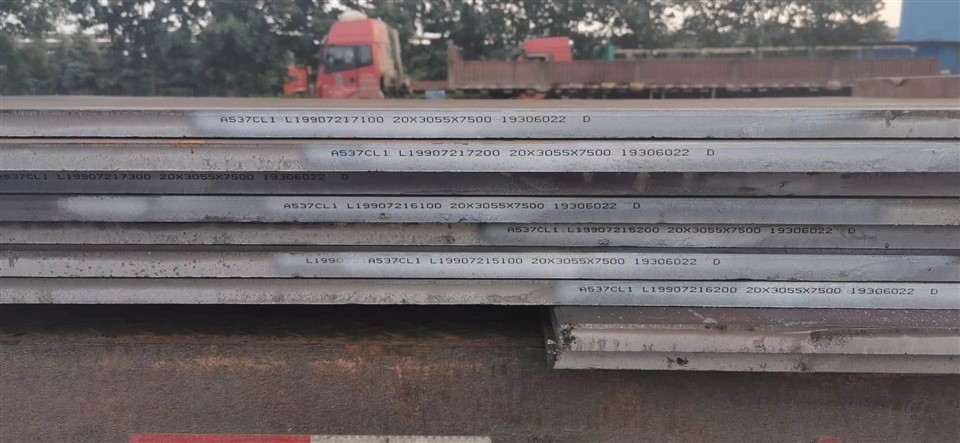


A537CL1 A537CL2 A537CL3 Asme Sa516
Introduction
ASME SA516 is a steel plate used in the production of pressure vessels and boilers. It is usually composed of carbon, manganese, silicon, sulfur, phosphorus, aluminum and other elements. A516 is classified according to different strength levels (such as 55, 60, 65 and 70), and the most common one is SA516-70.
Advantages
1. Chemical composition control
The manganese content of asme sa516 with a thickness of up to 40mm is controlled between 0.70% and 1.35%, while the manganese content of thicker steel plates is 1.00% to 1.60%. This helps to optimize the strength and toughness of the steel; the nickel content is limited to a maximum of 0.5%, which helps prevent the steel from being too brittle; the carbon equivalent (CE) is kept below 0.57%, which can control the hardenability of the steel and reduce the risk of cracking during its welding process. The lower the CE value, the better the welding performance of the steel is generally.
2. Good tensile strength
The tensile strength of asme sa516 with a thickness of ≤65mm ranges from 485 to 620 MPa. The tensile strength of thicker steel plates (up to 100mm thick) is between 450 and 585 MPa. The tensile strength of steel plates with a thickness of more than 100mm is maintained between 485 and 620 MPa.
3. High Sectional Shrinkage
The section shrinkage of asme sa516 with a thickness not exceeding 65 mm is 18%. The higher the shrinkage, the better the ductility of the steel when stretched.
4. Good Weldability
A537CL1 A537CL2 A537CL3 asme sa516 has good welding performance. Due to the low carbon content and reasonable alloy element ratio, the steel is not prone to defects such as cracks, pores and slag inclusions during welding, making it suitable for the manufacture of boilers and pressure vessels.
Applications
1. Boiler manufacturing
Asme sa516 is a commonly used material in boiler manufacturing, especially for the manufacture of medium and low pressure boilers, steam boilers and hot water boilers.
2. Pressure vessels
Asme sa516 is often used in the manufacture of pressure vessels, such as gas storage tanks, pressure storage tanks, liquid storage tanks, etc.
3. Chemical equipment
Asme sa516 is widely used in pipelines, reactors, heat exchangers and other equipment in the chemical industry.
4. Oil and gas industry
Used in the manufacture of oil and gas extraction, transportation and storage equipment, such as oil and gas storage tanks, pipelines, gas pressure vessels, etc.
5. Heat exchanger
Asme sa516 is suitable for the manufacture of heat exchangers, used for the wall panels or other structural components in the middle of the heat exchanger.
6. Shipbuilding
Asme sa516 is used in the pressure vessels and heating system components of some ships.
7. Tank manufacturing
Asme sa516 is widely used in the manufacture of various tanks, including oil, chemical, food and liquid storage tanks.
8. Hot water system and steam system
Asme sa516 is also used in some large hot water and steam systems, such as hot water transmission pipelines, steam pipes, etc.
9. Power equipment
In power plants, Asme sa516 is used to manufacture boilers, steam generators, pipelines and other pressure equipment.
10. Food and beverage processing
In the process of food processing and beverage production, some equipment, such as heaters and coolers, also use Asme sa516.
Characteristics of Asme Sa516
|
Steel grade |
Chemical position |
|||||||||||||||
|
C Ladle/product |
Mn |
P |
S |
Si |
Cu |
Nia |
Cr |
Mo |
||||||||
|
Thickness /mm |
Ladle |
Product |
ladle&product |
Ladle |
Product |
Ladle |
Product |
Ladle |
Product |
Ladle |
Product |
|
|
|||
|
A537CL1/ SA537CL1A537 CL2/SA537CL2,A537 CL3/ SA537CL3
|
≤ 0.24
|
≤40 |
0.70-1.35 |
0.64-1.46 |
≤ 0.025 |
≤ 0.025 |
0.15- 0.50 |
0.13- 0.55 |
≤ 0.35
|
≤ 0.38
|
≤ 0.25
|
≤ 0.28
|
≤ 0.25
|
≤ 0.29
|
≤ 0.08
|
≤ 0.09 |
|
>40 |
1.00-1.60 |
0.92-1.72 |
|
|||||||||||||
|
a The manganese content (melting analysis) of steel plates with a thickness of ≤ 40mm can reach a maximum of 1.60%; For all specifications of steel plates, the nickel content (melting analysis) can reach a maximum of 0.5%, but the carbon equivalent CE should not exceed 0.57%, where CE=C+Mn/6+(Cr+Mo+V)/5+(Ni+Cu)/15; At this time, the analysis results of manganese and nickel products shall not exceed 0.12% and 0.03% of their melting analysis results, respectively. |
||||||||||||||||
|
Steel grade
|
Specificaiton /mm
|
Tensile Rm/MPa |
Yield Rp0.2/MPa ≥ |
REDUCTION OF AREA≥ , % |
|
|
A200mm |
A50mm |
||||
|
A537 CL1/ SA537 CL1 |
≤65 |
485-620 |
345 |
18 |
22 |
|
>65-100 |
450-585 |
310 |
18 |
22 |
|
|
A537 CL2a/ SA537 CL2a |
≤65 |
550-690 |
415 |
- |
22 |
|
>65-100 |
515-655 |
380 |
- |
22 |
|
|
>100- 150 |
485-620 |
315 |
- |
20 |
|
|
A537 CL3a/ SA537 CL3a |
≤65 |
550-690 |
380 |
- |
22 |
|
>65-100 |
515-655 |
345 |
- |
22 |
|
|
>100- 150 |
485-620 |
275 |
-
|
20 |
|
For A537 CL2 and A537 CL3 with a nominal thickness of less than 20mm, a 40mm wide rectangular specimen can be used for tensile testing, and the elongation is measured using a 50mm gauge distance. The elongation is A50mm
FAQ
Q: What is the chemical composition of A537CL1 A537CL2 A537CL3 asme sa516?
A: The main chemical components of asme sa516 include carbon (C), manganese (Mn), silicon (Si), sulfur (S) and phosphorus (P), and the specific content requirements may vary according to different grades (such as SA516-70, SA516-60).
Q: How to weld asme sa516?
A: Asme sa516 can be welded by common welding methods, including arc welding, gas shielded welding, etc. For thicker materials, preheating and post-heat treatment may be required.
Q: What is the hardness grade of asme sa516?
A: The hardness grade of asme sa516 is generally between 170 and 210 Brinell hardness (HB), depending on the heat treatment and thickness of the material.
Q: What are the standard certifications for asme sa516?
A: Asme sa516 generally complies with ASTM A516 standards and can obtain quality management certifications such as ISO 9001 to ensure that its performance meets international standards.
Q: What is the manufacturing process of asme sa516?
A: The manufacturing process of asme sa516 includes forging, rolling and heat treatment, etc., to ensure that the material has excellent mechanical properties and structural stability.
Q: What temperature range is suitable for asme sa516?
A: SA516 is suitable for environments with a wide temperature range and can generally be safely used between -50°C and 450°C. The specific temperature range depends on the material grade and application requirements.
Q: How to check the quality of asme sa516?
A: It can be checked by conventional mechanical property tests (such as tensile test, hardness test) and chemical composition analysis to ensure that it meets the standard requirements.
Q: What is the common thickness of asme sa516?
A: The common thickness of asme sa516 is 6mm to 50mm, and the specific thickness can be customized according to customer needs and design requirements.
Q: What are the heat treatment requirements of A537CL1 A537CL2 A537CL3 asme sa516?
A: Asme sa516 usually needs to undergo heat treatment processes such as normalizing or annealing to improve its mechanical properties, ductility and crack resistance.
Hot Tags: A537CL1 A537CL2 A537CL3 Asme Sa516, China A537CL1 A537CL2 A537CL3 Asme Sa516 manufacturers, suppliers, factory, oval steel plate, weldable steel plate, precision steel plate, formable steel plate, customized steel plate, length steel plate


